
Why ventilation matters
A greenhouse traps heat and moisture. That’s the point, but it’s also the problem. Without enough ventilation, temperatures spike on sunny days, humidity builds and disease follows. Plants also need fresh air and carbon dioxide to photosynthesise.
Good ventilation is the single most valuable climate investment most growers can make.
How natural ventilation works
Warm air rises. If you give it somewhere to escape at the top, cooler air is drawn in lower down. That “chimney effect” is why roof and ridge vents are so effective, and why pitched roof greenhouses ventilate better than low tunnels.
Wind adds to the effect. Vents on the windward and leeward sides let air flow right through.
Ventilation options
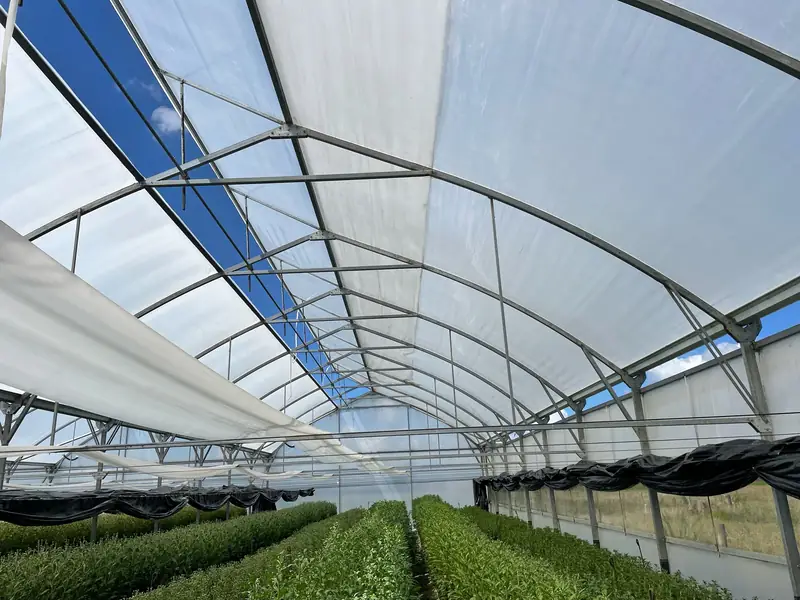
- Roof or ridge vents. Hot air escapes at the top. Manual or automated.
- Roll-up sidewalls. Open the sides of tunnelhouses for cross-flow.
- End-wall openings and doors. Useful for smaller structures.
- Extraction fans. Mechanical airflow where natural ventilation isn’t enough.
- Shade screens. Cut incoming heat and light on the hottest days.
How much ventilation do I need?
As a rule, the more vent area you have, the better, within reason. Crop type, region and structure size all matter. High-light, warm regions need more than cooler, cloudier ones.
Your builder should be able to explain how much vent area the design provides and how it compares with your needs.
Manual or automated?
Manual vents are fine if someone is on site to open and close them as conditions change. Automation earns its keep when you can’t be there, when the weather changes quickly, or when precise control is worth money to your crop.
A good compromise: choose a structure that allows automation, start manual, and add drives and a controller later.
Common ventilation mistakes
- Too little vent area for the structure.
- Vents on only one side, so air doesn’t cross-flow.
- Forgetting to open vents early on warm mornings.
- Blocking vents with crop, benches or shade cloth.
- Leaving vent drives unserviced until they fail.